
The Signal · Public overview

The Signal

Finding meaning in the noise.

A research experiment exploring whether specialized AI perspectives, disciplined cross-checking and independent risk review can make investment research more systematic.

Proprietary research system. Public overview only.

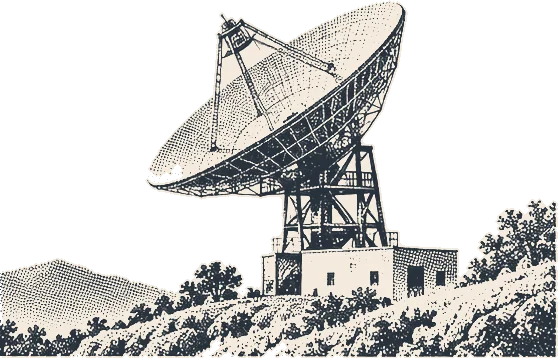
Halftone illustration of a large radio telescope dish on a steel frame, set on a wooded hillside.
Fig. 1 Most of the work is listening carefully.

A question before an answer.

Every Serpenthink project is described the same way: the problem, the hypothesis, the leap of imagination, the experiment and what it has taught so far.

  1. The Problem Defined
  2. The Hypothesis Stated
  3. What if? Asked
  4. The Experiment Successive prototypes
  5. What We Learned Early, still open

01 The Problem

Too many sources, not enough sense.

An independent investor may need to reconcile earnings reports, SEC filings, options markets, macroeconomic conditions, policy developments, company fundamentals and conflicting opinions.

Those sources are fragmented, uneven in freshness, sometimes incomplete and difficult to weigh together. No single screen or language-model response can be relied on to resolve every uncertainty.

02 The Hypothesis

Many perspectives, under human oversight.

A coordinated set of specialized analytical roles may help organize contradictory inputs, reveal omissions, challenge a thesis from several directions and flag risk before a person makes a decision.

This is a testable hypothesis, not proven superiority over ordinary research, a professional desk or a single strong model. Agreement between roles is not independent verification.

03 What if?

What if?

What if an investment thesis had to withstand an adversarial research briefing (technical, fundamental, macro, regulatory, liquidity and portfolio risk) before anyone considered committing capital?

04 The Experiment

Built through successive prototypes.

The idea traces back to around 2003, during the founder’s finance studies. A modern exploratory version began in late 2025 as The Serpentine Signal. An early four-role prototype grew to seven roles in early 2026, followed by work on data intake and infrastructure, and then a proposed seventeen-role working architecture.

Founder-reported history. Live integrations, production readiness and independent test results have not been verified, and the full architecture is not described here as running continuously on live data.

05 What We Learned

Process matters more than headcount.

Early experimentation suggests that process discipline, source freshness, disagreement logging and explicit risk checks matter at least as much as the number of models involved.

The project has raised useful questions about correlated model error, false consensus, volatility, fragile financial statements, and how hard it is to tell narrative momentum from durable economics.

Whether any of this improves investment outcomes remains an open empirical question. More complete, timestamped evidence is needed before attributing any avoided loss, selection or risk reduction to the architecture.

From raw inputs to a structured briefing.

A public summary of the research flow. The detailed rules, prompts and data sources stay private.

  1. Intake

    Normalize documents and identify stale or conflicting inputs.

  2. Analysis

    Consider charts, fundamentals, capital structure, market breadth, options liquidity, prediction-market odds, policy and institutional disclosures.

  3. Challenge

    Compare the positive and negative cases. Record uncertainty, alternative explanations and missing evidence.

  4. Risk review

    Inspect leverage, concentration, event exposure, option structure and portfolio constraints. Surface veto conditions for human review.

  5. Synthesis

    Produce a structured research briefing with evidence, counterarguments, conditions and a decision status.

The working design uses several AI models as complementary tools for research, document parsing, comparison and adversarial critique. The system supports research; it is not an autonomous investment adviser and does not guarantee results. A person makes every decision.

Seventeen analytical roles.

Each role is a defined research mandate inside the experiment, numbered 00 to 16. This is a working architecture, not a record of performance, and not every role is described as operating on live data.

Intake

Collect, clean and check inputs before anyone relies on them.

  • 00Intake, ledger hygiene & anomaly audit

Analysis

Examine an idea from complementary angles.

  • 01Technical geometry & volatility bands
  • 02Prediction markets & probability divergence
  • 03Macro sentinel & market breadth
  • 04Social sentiment & narrative velocity
  • 05Options liquidity & volatility surface
  • 06Institutional flow & 13F filings
  • 08Infrastructure & competitive moats
  • 09Legislative, regulatory & policy catalysts
  • 12High-beta momentum & tactical velocity
  • 13Events & earnings timeline
  • 14Fundamental & unit-economics forensics

Synthesis

Bring evidence and disagreement together.

  • 07Conviction synthesis & research status

Guardrails

Look for reasons to slow down or stop.

  • 10Patience, pullbacks & income risk
  • 11Capital recovery & position-sizing stress tests
  • 15Portfolio correlation & account constraints
  • 16Tail-risk & balance-sheet veto

Internal role names, mandates, prompts, data sources and decision rules are private and are not published here.

Kill Switch / Experiment closed

When the evidence fails, the briefing stops.

If a research path depends on missing or stale data, untraceable market claims, contradictory financial information, unrealistic option liquidity or a breached exposure limit, it is designed to halt that path for human review.

  1. 01What we attempted
  2. 02What we observed
  3. 03What we decided
  4. 04What we learned

    Nothing recorded yet. A case study will appear here only when a real, documented example can be shared without exposing private research.

    Public story, private engine.

    On this site

    • The question and the method. What the experiment is trying to learn, and how.
    • The research flow. A summary of intake, analysis, challenge, risk review and synthesis.
    • Honest status. What is founder-reported, what is unverified, and what remains open.

    Kept private

    • The application itself. No tools, logins or outputs are available here.
    • Research and rules. Prompts, mandates, decision rules and private reports.
    • Financial information. Holdings, positions, signals, account constraints and credentials.
    If a tool is ever offered

    It would live as a separate, access-controlled application with its own legal and data review, not as a hidden page on this site. Nothing like that is available today.